


 Go back

Sports, recreation and physical activity cluster
Pedaling through Cundinamarca
 Help and support center
 Accesibility
 Rate your expirience
How can we help you?


We want to improve your experience
Your experience inspires us to improve. Please rate our website using the following survey.
If you wish to make a request, petition or suggestion, you can do so through our SPQyF system and contact us:
 Back
Back
Route of the Condor
Chipaque - Ubaque - Choachí

Level of complexity: ◉◉◉◉◎
This route is a true journey into the bowels of Muisca mythology, according to which the condor is the spirit of the earth, the one that allows the connection between men and nature. The legend tells that in the times when the world was in total darkness, Chiminigagüa, the original creative light, emanated a great amount of colored lights, each one crystallized in the beak of a giant, imposing and sagacious bird. Since then, the Muisca people not only worshipped the sun and the moon, but also began to respect the condor as a sacred bird and messenger of the gods.
It is believed that this is the origin of the name of the department of Cundinamarca, but there are several versions. The first one says that it has its origin in the Chibcha Kunturmarqa, which means 'nest of the condor'. Another suggests that with the arrival of the Spaniards to what we know today as the Cundinamarca highlands, the term Cundirumarca, used by the Indians to refer to their sacred temple, became popular and was later changed to Cundinamarca, which in Spanish translates as 'province or region of the condor'. Finally, some researchers affirm that the name comes etymologically from the Quechua kantur, kandur, cundur or condor, while the suffix 'marca' would mean region or colony, that is, the 'region or colony of the condor'.
We are then before the sacred land of the condor, the golden kingdom of the wind god, as it was also baptized by the Muiscas. During the tour we will contemplate places of worship of our ancestors as the Laguna de Ubaque, while we travel the back of the eastern hills of Bogota, at an altitude that can reach 2,699 m/snm.

The 58.3 kilometers of this route, designed and signposted by the RAPE, pass amidst the alternation between the mountains of the Eastern Cordillera of the Andes and the sound of the waters of the Palmar River, which rises in Ubaque and flows into the Blanco River in Choachí. With 29% of the road unpaved and an average gradient of 7%, it is quite a challenge for mountain bike lovers.
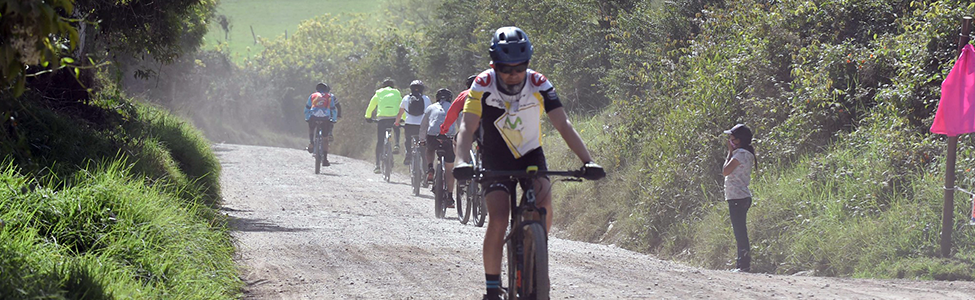
The starting point is the main square of Chipaque, where the Parish of Our Lady of the Rosary is located, a religious precinct that dates back to 1731. It was one of the first parishes of the Archdiocese of Bogotá, and the second in eastern Cundinamarca after San Miguel de Choachí.
This municipality offers alternatives for the practice of extreme sports such as Xtreme Park Chipaque, which has plans for paragliding, canopy, rappel or paintball. But if your thing is food, piqueteaderos such as Doña Chelita, Helenita, Lolita, Chispa or Carmen Julia, will be ready to serve you with the best of local cuisine.
From the main park we head to the road that leads from Chipaque to Ubaque. There, the first thing we will encounter is a seven-kilometer climb that, although it seems harmless, unexpectedly surprises us with a hard slope of approximately 11% inclination. Then comes a 13.8 kilometer downhill descent, with some stretches of unpaved road. Caution, prudence and good technique.
After the descent comes a small third category pass of 3.7 kilometers and a maximum gradient of 9.3%. Once we reach the top, we will be in the territory of Ubaque and once there you can not miss the Laguna de Ubaque, an ancient place of worship and adoration of the Muiscas who inhabited the lands of Cundinamarca. There are ecological hikes that range from two to five hours long, and if you wish there is also a wide range of camping or cabins.
Up to this point we are 6.7 kilometers from Choachí. A fairly quiet stretch until the ascent with 1.7 kilometers to go to the village. A climb with ramps up to 9% inclination, make the arrival to Choachí a small victory that draws smiles on the sweaty faces of the cyclists.
Choachí offers different ecotourism alternatives to liven up the ride. Visiting La Chorrera is a plan not to be missed. It is considered the highest waterfall in Colombia with 590 meters, the sixth in South America and number 60 in the world, its waters come directly from the moor and are 100% potable.
Finally, on the way back to Chipaque, a couple of slopes will test your endurance. The first at kilometer 3.5 with an incline of 19% and the second at kilometer 10, after passing Ubaque, with slopes ranging from 11 to 20% and fluctuating for 10 kilometers more. What remains is an 8-kilometer stretch of false flat and downhill before the finish line that your legs will thank you for.
Flying finish:
Of course, talking about Choachí and not mentioning its famous Santa Monica Hot Springs would be a sin. So this destination, just 2.6 kilometers from the main park of Choachí, is undoubtedly one of the most important attractions of eastern Colombia. It is a spring of volcanic waters to which therapeutic effects are attributed and whose history dates back to the decade of the thirties when they were just a few showers. Today, of course, it is a whole aquatic complex whose water currents serve pools and jacuzzis that can be enjoyed from the hotel that bears the same name: Termales Santa Monica.
In Choachí, don't forget to visit the Derracamandaca Farm, a unique experience for the whole family where everyone will learn what a farmer lives in a day. You will begin by milking and learning about the utilities and processes that milk needs for its production and commercialization. Then they will feed the animals and collect the eggs from the hens, to later enjoy a delicious lunch made with the farm's products. At the end they will go to the vegetable garden and will be able to make homemade bread in the wood oven.
Was this content useful to you?


Share it on:


