


 Go back


La CCB
 Help and support center

 Accesibility
 Rate your expirience
How can we help you?


Your experience inspires us to improve. Please rate our website using the following survey.
If you wish to make a request, petition or suggestion, you can do so through our SPQyF system and contact us:
 Back

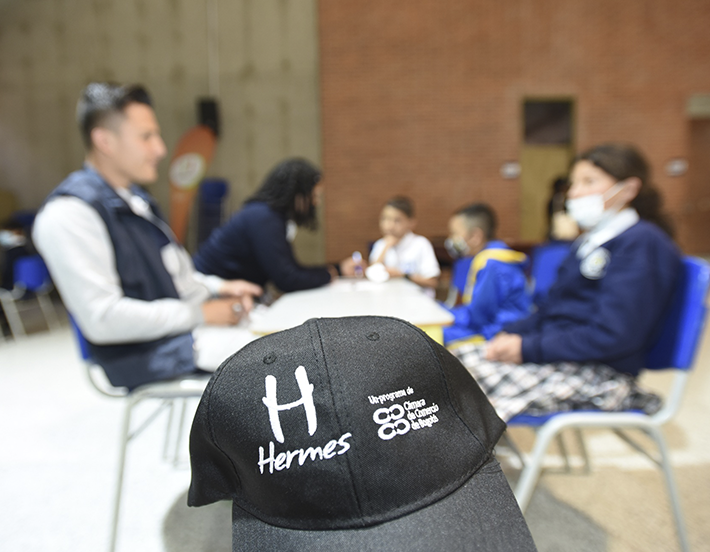

· According to data from the Hermes program, peer mediation reduces violence and leaves learning in 92% of cases.
Bogotá D. C., November 2026. In schools, conflicts They appear on the field, in the classroom or after class. The question is what is it done with them? The HERMES Program of the Arbitration and Conciliation Center of The Bogotá Chamber of Commerce works tirelessly to resolve them with dialogue, agreement and Conflict Resolution Mechanisms (CRM), not with screams or hits.
The initiative seeks to resolve conflicts peacefully, prevent bullying and cyberbullying, train and certify as mediators students between 12 and 18 years old, and link teachers, counselors, managers and families. Its focus is on the development of skills to manage differences and prevent tensions from escalating.
The data collected by the HERMES Program show the dimension of the challenge in terms of school coexistence. In Bogotá they have attended 8,637 cases and in the region 5,395, for a total of 14,032 situations addressed. Likewise, in Bogotá and the region, actions have been developed awareness that has reached 52,476 people, contributing to the strengthening coexistence and peaceful resolution of conflicts.
The profile of the school conflict is close. In 49% of cases the parties are friends and in another 49% they are colleagues, while the disputes with family members or boyfriends represent just 1% each. By ages, 42% of cases involve students ages 11 to 13 and 37% to children from 8 to 10 years old. Overall, 79% of the situations are concentrated in childhood and preadolescence, a decisive stage to learn to resolve differences.
As for the associated behaviors, insults (1992 records) and beatings (1,920) top the list, followed by gossip (1,590) and nicknames (1,570). This indicates that verbal and physical aggression They are the most frequent manifestations of school conflict.
Where do conflicts occur?
According to the cases attended, 50% of conflicts occur in the living room and 39% in recreational areas. Bathrooms and entrances and exits They concentrate 4% each, and social networks 3%. The perception of educational community consulted points in a similar direction, although with another order: the court (277 mentions), the entrance or exit (222) and the room (189) They are the spaces that worry the most.
What students and teachers feel
The consultation with 775 members of the educational community in Bogotá shows that 57.42% perceive the conflict in a negative way, 23.74% of neutral way and 18.84% as a constructive opportunity. The emotion dominant is anger (476 responses), followed by fear (188), sadness (41), joy (18) and surprise (15).
In the face of a conflict, the most common reaction continues to be confront and discuss, with 46.45%. However, 23.23% go to mediator and 14.19% propose solutions, which shows that dialogue already wins space. Friends are the main support network (361 mentions), above of parents (197) and teachers (144), which makes it even more relevant to train the students themselves as mediators.
Mediation leaves its mark
The results of mediation are one of the most important data forceful of the program. 50% of participants claim to have learned that problems have solutions, 21% that emotions can change and another 21% who can understand the other. In total, 92% took a learning, and only 8% say they have not learned anything.
Gustavo Andrés Piedrahita, vice president of the Arbitration Center and Conciliation of the Bogotá Chamber of Commerce stated “When A child or young person learns to mediate, not only resolves a conflict: he or she learns to listen and put yourself in the other's shoes. That 92% of those who pass through the mediation takes learning confirms that schools can be “spaces where differences are discussed and not resolved with violence.”
Recognition of mediators
On October 29, the VI Meeting was held in Ágora Bogotá Annual of the Youth Network of Mediators, a space to share experiences, celebrate the achievements achieved during the year and exalt the leadership of the young people who make school mediation a tool to build better relationships and strengthen coexistence in their educational communities.
The figures confirm that, when students have tools and support, conflicts can become a opportunity for learning and coexistence.


