


 Go back

Sectorial
 Help and support center
 Accesibility
 Rate your expirience
How can we help you?


Your experience inspires us to improve. Please rate our website using the following survey.
If you wish to make a request, petition or suggestion, you can do so through our SPQyF system and contact us:
 Back
Back
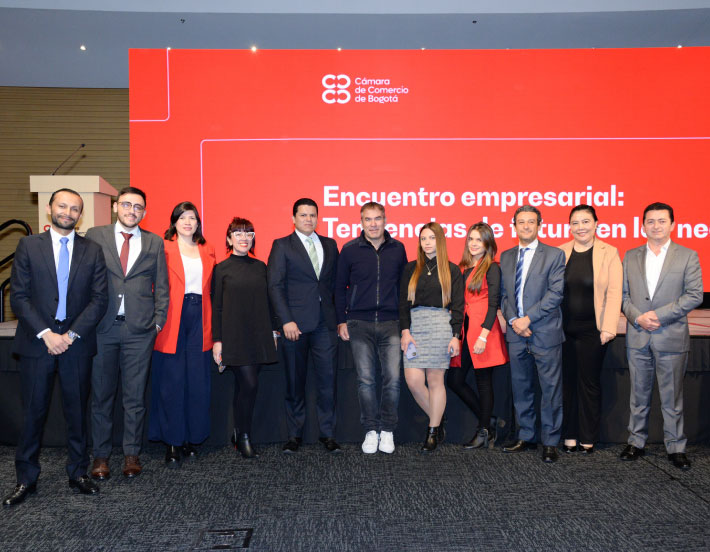
Within the framework of the First Great Ibero-American Summit on Sustainability and Innovation for Business, the president of the Bogota Chamber of Commerce and president of the World Federation of Chambers of Commerce, Nicolás Uribe Rueda, reminded that the Chambers of Commerce in the world are the allies of the business sector to open new markets and advance in trade exchange and integration processes. The Vice Minister of Business Development, María Fernanda Valdez, presented the National Government's guidelines for the productive sector.
The event was attended by speakers of international stature such as Ha-Joon Chang, South Korean economist and professor at SOAS, University of London; María Fernanda Garza, president of the International Chamber of Commerce; Alan Mac Carthy, co-founder and president of Front; Ian de Cruz, global director of P4G.
The Bogota Chamber of Commerce, in alliance with the World Chambers of Commerce Federation, held the first Great Summit on Sustainability and Innovation for Business, so that more than 600 businessmen and businesswomen from all over Ibero-America could connect with business leaders from different countries and international panelists, while exchanging experiences in innovation and sustainability for the acquisition of new businesses.
The event was inaugurated by the president of the Bogota Chamber of Commerce and also president of the World Chambers of Commerce Federation, Nicolás Uribe Rueda, who reminded attendees of the key role played by the chamber system as a bridge between governments and citizens:

Chambers of commerce are the ones called to promote public-private articulation in the implementation of policies that encourage and facilitate development, and they are the ones who can convene and make attractive markets available to SMEs. Chambers can jointly build solutions to the problems of the business sector and promote structural transformations in the business model to make them sustainable and productive.
Likewise, in his installation speech, Uribe Rueda called for the productive sector to be increasingly sustainable and purposeful:
I have no doubt that there are more and more of us who believe that a sustainable business action over time is not only the one that is more productive, but the one whose success also depends on the achievement of a triple impact: economic, social and environmental. I am talking about companies with purpose, those that produce better, that produce more with less and that do so hand in hand with the communities in which they operate, companies that, for example, are efficient while closing gender gaps and contributing to mitigating the effects of climate change.
For her part, the president of the International Chamber of Commerce, María Fernanda Garza, reminded the attendees of the enormous support required by micro, small and medium-sized companies around the world to overcome the current global crisis impacted by the war in Ukraine, the effects of the pandemic and inflation.
In Latin America we need governments and businesses to work in cooperation to maintain the economy and jobs. More than 60% of MSMEs have lower incomes than they did before the pandemic and this directly impacts households. In developing countries, families have lost 1.5% of their income, just because of the increase in maize and wheat. As a business community we must be a source of solutions to solve today's challenges through innovation, but innovation cannot happen in a vacuum.
Also, at the inauguration of the event, the Vice Minister of Business Development of the Ministry of Commerce, Industry and Tourism, María Fernanda Valdez, presented the National Government's guidelines on sustainability and innovation. Specifically, Vice Minister Valdez pointed out that the Government seeks to:
Transition from an extractive economy to a productive and sustainable economy, strengthening the economic and social integration of Latin America and the Caribbean, inserting the country into globalization and projecting Colombia as a competitive, sustainable and peaceful tourist destination.
To this end, the government of President Gustavo Petro has set three objectives to work hand in hand with the business sector: environmental sustainability, contribute to closing technological gaps and promote productive linkages that generate employment, wealth and reduce inequalities.
During the first day of the Summit, Ian de Cruz, global director of P4G, said:
What we are asking companies and businesses to do is to see these national climate action plans and Sustainable Development Goals not just as environmental plans, but as real business sources for sustainable solutions.
In addition to the conferences, during the first day 112 companies held networking and business meetings, 28 companies in the Manufacturing Hall, more than 50 service companies, 14 companies in Agrifood and 20 companies in environment and energy. These meetings will continue tomorrow and Thursday of this week.
The summit's keynote address was given by South Korean economist and professor at SOAS, University of London, Ha-Joon Chang, who spoke about the new challenges facing the business sector in the global context.
Regarding sustainability and innovation, Chang recalled that:
The business strategies of the 21st century must incorporate innovation, inclusion and sustainability, and although it may sound challenging to pursue all three simultaneously, their objectives complement each other. Without innovation, sustainability (economic, political, social and environmental) is impossible and inclusion difficult.
With inclusion, companies and economies are more innovative as it generates diverse thinking and makes workers more open to new technologies and more sustainable. Greater sustainability brings greater stability, which helps companies and nations become more innovative and inclusive.
The second day of the summit will address innovation issues and will feature Xavier Sala-i-Martín, professor at Columbia University, Barry Katz, professor at Stanford University, Kwaak Young-Hoon, founder and president of World Citizens Organization, Taryn Marie Stejskal, founder and president - Resilience Leadership Institute, Giuliana Huamán, co-founder and president of Miah and Mariana Vélez, director of Inventta Latin America, among others.
This summit is the first major milestone of the global plan that Nicolás Uribe Rueda, as president of the World Chambers of Commerce Federation, presented to strengthen MSMEs, which has four axes: empowerment of women, sustainability, access to markets and adoption of digital tools. The summit runs until October 26.


