


 Go back

strengthen your company
 Help and support center
 Accesibility
 Rate your expirience
How can we help you?


Your experience inspires us to improve. Please rate our website using the following survey.
If you wish to make a request, petition or suggestion, you can do so through our SPQyF system and contact us:
 Back
Back
This guide provides a step-by-step path for SMEs to follow to prevent and address adverse human rights impacts, and guidance on how to act when an adverse human rights impact is generated.
This will allow SMEs to be aligned with Responsible Business Conduct in order to consolidate a business model that not only generates economic profitability, but also has a positive impact on communities, employees, the environment, community, suppliers and surroundings.
Bogota, July 6, 2022. The Bogota Chamber of Commerce, in alliance with the Ideas for Peace Foundation and the multi-stakeholder initiative Guías Colombia, launched a step-by-step guide for small and medium-sized companies to implement human rights due diligence processes.
Human rights due diligence is an ongoing management process that a company must carry out in light of its circumstances to address its responsibility to respect human rights.
In the guide, managers, workers and SME leaders will find activities and tips to implement human rights due diligence in a practical, simple and creative way. The guide also includes an ABC of human rights, describing how companies can handle situations where they are involved in human rights violations and how to prevent these scenarios.
The document presents six general guidelines: first, companies must define the relevant groups in human rights; second, build and have a human rights policy; third, identify and prioritize human rights impacts; fourth, define measures to prevent and mitigate the prioritized human rights impacts; fifth, monitor the effectiveness of the measures implemented; and sixth, communicate to stakeholders the actions developed by the company on human rights issues. The guide points out that it is essential that the HR due diligence strategies established by companies have a process of continuous improvement through the PHVA cycle: Plan-Do-Check-Adjust.
Nicolás Uribe Rueda, president of the Bogota Chamber of Commerce, highlighted the launch of this document and pointed out the importance for SMEs to implement it in their operations:

Today, the private sector has adapted to respond to the needs of social responsibility demanded by audiences that are increasingly informed and interested in social benefit, and through innovation it is able to generate positive impacts on the environment. In this guide, small and medium-sized entrepreneurs will find the answer on how to do it.
The demands of today's market require that SMEs, in addition to increasing their competitiveness and productivity, adopt better international standards such as the Guiding Principles on Business and Human Rights and Responsible Business Conduct (RBC). For example, the OECD Survey on RECs in Latin America and the Caribbean in 2021 showed that SMEs have difficulties in adopting responsible business practices and due diligence processes. According to the survey, SMEs have limited financial and human resources, as well as limitations in understanding information on REC and how it can be applied in their own organizations. The guide helps to break down these barriers.
This Guide is based on the premise that a business fabric that is respectful and attentive to human rights is the basis for creating sustainable, lasting and competitive businesses, while at the same time contributing to building a better country. Companies that implement a Responsible Business Conduct in Human Rights can reap rewards in terms of competitiveness, reputation, staff retention, sustainability, among others.
For example, in terms of competitiveness, companies can participate more easily in the national and global economy and guarantee sustainability. Likewise, it responds to the growing expectations of its investors in terms of management of labor, environmental and human rights issues. Additionally, it benefits participation in the global supply chain and decreases the likelihood that companies will face lawsuits.
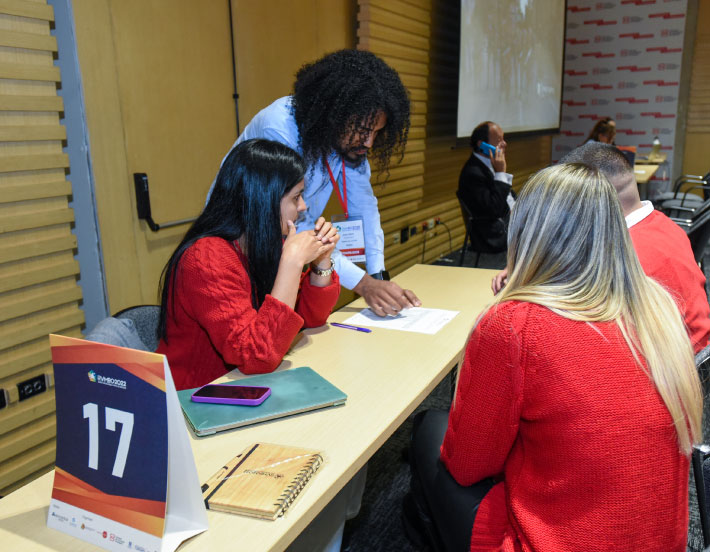
The guide was developed jointly with small and medium-sized entrepreneurs, trade associations, experts in Responsible Business Conduct and academia. A total of 24 managers, directors and leaders of SMEs from different economic sectors participated and contributed their knowledge and experience. Through interviews, procurement and supply areas were consulted and 2 workshops were held with SMEs, with whom the Guide was developed taking into account their needs.
At the Bogota Chamber of Commerce, small and medium-sized entrepreneurs have tools to help them implement such strategies. For example, a free virtual course on Responsible Business Conduct with emphasis on human rights from the business sector is available.


