


 Go back

La CCB
 Help and support center
 Accesibility
 Rate your expirience
How can we help you?


Your experience inspires us to improve. Please rate our website using the following survey.
If you wish to make a request, petition or suggestion, you can do so through our SPQyF system and contact us:
 Back
Back
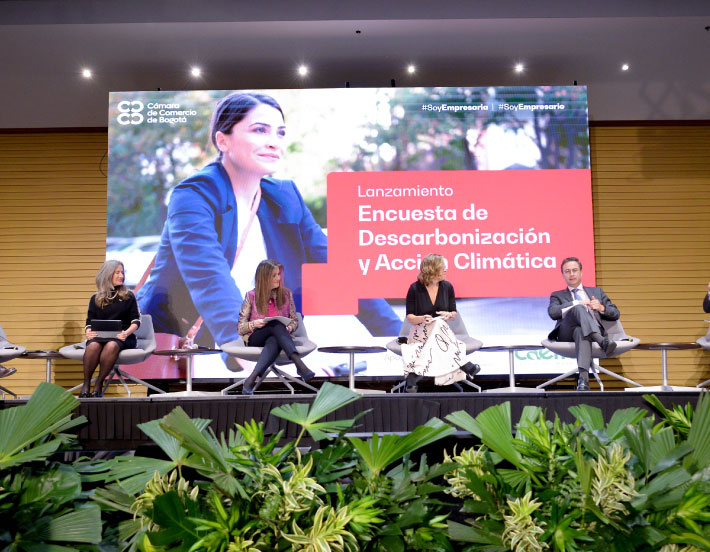
51% of the companies surveyed are aware of the concept of climate change and the measures to be implemented in their organizations to mitigate it. Most of the businessmen (73%) surveyed do not know what decarbonization, carbon neutrality (86.2%) or the government's goals for reducing greenhouse gases (57.2%) are.
The three main risks associated with climate change identified by companies are the increase in raw material prices (60%), the increase in natural disasters (34%) and permanent changes in temperature (34%).
The CCB presented recommendations in areas such as knowledge generation, training, financing and best practices to make progress on climate change.
In response to this, the CCB presented a technical guide for interested companies to begin their path towards decarbonization, with a special focus on small and medium-sized companies.
As part of its Responsible Business Conduct strategy, the Bogota Chamber of Commerce (CCB) and its subsidiary Corporación Ambiental Empresarial (CAEM) conducted a survey of 1,513 companies in Bogota and 59 municipalities in Cundinamarca to determine the level of implementation of measures to decarbonize their operations, that is, how much they reduce carbon emissions into the atmosphere to contribute to the goals set by the country in the face of climate change.
The survey, which will be conducted every two years to verify progress in this area, seeks to measure how vulnerable businessmen and businesswomen feel to the risks arising from climate change, both in terms of natural impacts, as well as through possible adjustments to regulations and market fluctuations.
With these actions, the CCB seeks to promote, in coordination with public and private actors, strategies to provide tools to companies to strengthen themselves in this area and implement joint projects.
As a result of this work, the Bogota Chamber of Commerce made available to entrepreneurs a guide to identify the main sources of consumption of fossil fuels and electricity in their companies, and evaluate how to reduce their emissions and adapt their business models to move towards decarbonization.

Nicolás Uribe Rueda, president of the Bogota Chamber of Commerce, emphasized that this diagnosis is a starting point to establish an environmental sustainability roadmap for companies. "We put at the service of entrepreneurs a guide so that they can carry out processes that allow, through decarbonization, to generate high-impact changes for their businesses and for the community in general in favor of a more sustainable business environment."
Knowledge and perception of companies regarding climate action:
51% of respondents are aware of the concept of climate change and the measures to be implemented in their organizations. In contrast, 6% of the companies do not know this concept.
Most of the businessmen surveyed (73%) do not know what decarbonization, carbon neutrality (86.2%) or the government's goals for reducing greenhouse gases (57.2%) are.
Among the companies in the three sectors surveyed (manufacturing, commerce and services), those in the manufacturing sector are the ones that perceive themselves to be the least related to these issues.
Four out of 10 entrepreneurs surveyed consider that their operations are not related to climate change.
The three main risks associated with climate change identified by companies are the increase in raw material prices (60%), the increase in natural disasters (34%) and permanent changes in temperature (34%).
The main internal challenges for making progress in mitigating and adapting to climate change identified by the companies are the lack of knowledge about: the technical implementation of some measure (73%), related regulations (73%) and projects where the organization can participate (71%).
Reforestation processes and carbon certificates are attractive alternatives for companies, especially in the manufacturing and services sectors, as well as for large and medium-sized companies.
Six out of 10 companies have not taken any actions to address climate change.
The manufacturing sector is the sector in which the lowest percentage of companies report having taken any action related to measures to address climate change (21.5%).
Lack of access to tax incentives, not having technical assistance or specialized training, and lack of access to financing mechanisms are the main challenges identified by companies.
Ease of access to environmentally friendly technologies could motivate companies to commit to the transition to decarbonization.
Based on the above conclusions, the CCB identified the following opportunities and recommendations:
Promote research and analysis on vulnerabilities of different sectors to climate change.
Garantizar la difusión y el conocimiento de la normatividad ambiental a través de esfuerzos conjuntos entre agremiaciones y sector empresarial.
Promote spaces and tools to deepen the knowledge of companies regarding climate change and the actions they can implement.
Promote the appropriation of methodologies for monitoring, follow-up and measurement of environmental indicators in organizations.
Promote and expand, through Bancóldex, FDN and Findeter, the portfolio of services and products for financing projects to establish business models with alternative energy sources and low fossil fuel consumption.
Leverage the interest of companies in the implementation of measures related to climate change and decarbonization through the establishment of articulated plans between actors from the public, private and international cooperation sectors, in order to achieve national goals in terms of their greenhouse gas emissions.
Promote corporate climate action projects with nature-based solutions such as restoration and reforestation.
Encourage demand for sustainable goods and services through market strategies that promote responsible and conscious consumption.
Visibilize initiatives that are being implemented by associations and/or foundations to address climate change and intensify synergies around projects that address these issues.
With this diagnosis and in response to the need to develop technical knowledge mechanisms, the Chamber created a decarbonization guide with special emphasis on micro, small and medium enterprises. In it, they will find some key definitions, sector contexts, success stories and a series of steps, measures and mechanisms for accessing financing so that, in a simple but rigorous way, they can advance in their actions towards decarbonization and carbon neutrality.
Given that each sector is diverse, companies can adopt this document as a flexible guide that allows them to evaluate the possible steps to follow and try to go through some of the proposed stages, identifying opportunities for savings and emission reductions, setting clear goals to contribute to the country's goals and thus face this climate crisis.


