


 Go back

Negocios
 Help and support center
 Accesibility
 Rate your expirience
How can we help you?


Your experience inspires us to improve. Please rate our website using the following survey.
If you wish to make a request, petition or suggestion, you can do so through our SPQyF system and contact us:
 Back
Back

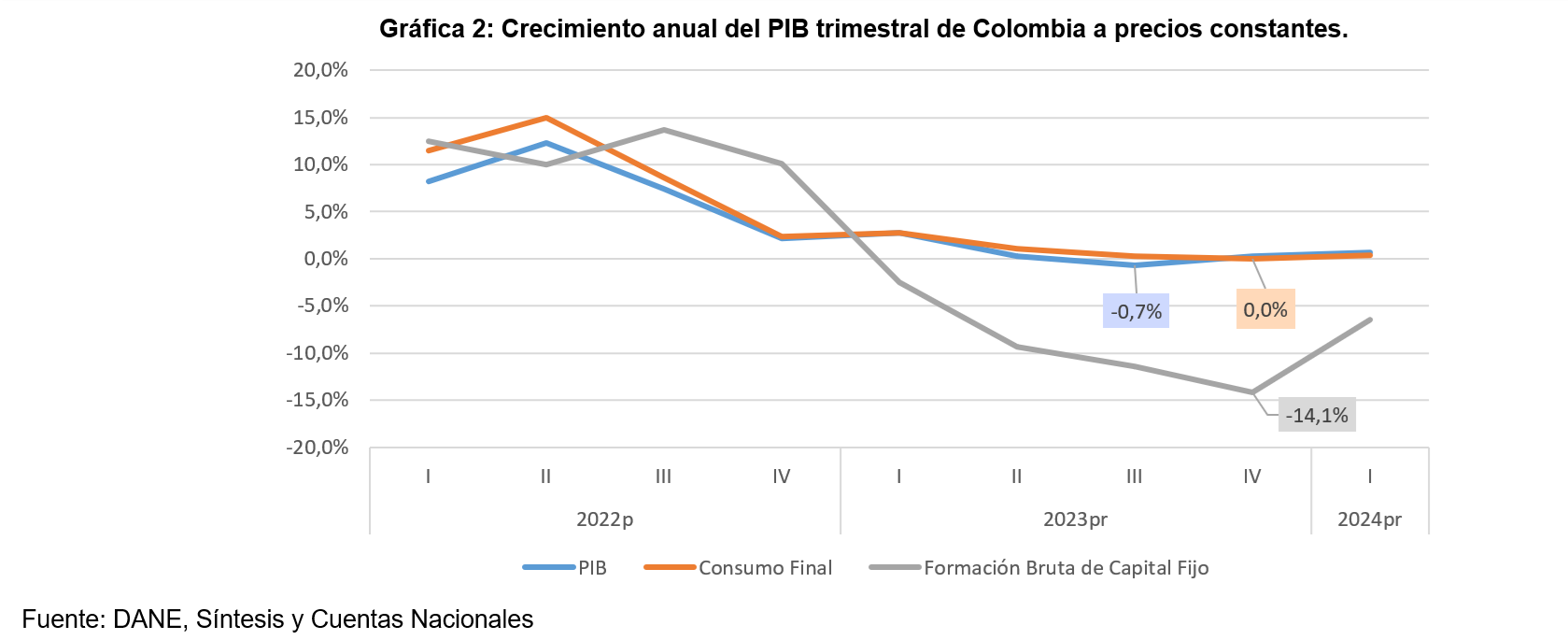
Economic statistics for the first quarter of the year have shown a series of important challenges regarding the country's economic situation. In particular, the economy has shown a progressive process of deceleration with a consolidated growth of 0.7% for the first quarter of 2024, according to official information from DANE. Also, key sectors for the economy have shown economic difficulties, as in the case of industry, which continued to fall by 5.9 %, commerce, which fell by 0.8 %, and construction, which grew by only 0.7 %, after 5 consecutive periods with negative results. On the demand side, the greatest difficulties have been observed in gross fixed capital formation, which economists approximate to the general measure of investment, where falls of more than double digits were observed during 2023. Consumption has not fallen, but had near-zero growth in several periods last year.
Although there is an open debate on the different causes of these results, there is a relative consensus that the most determining element is associated with inflation and its relationship with the cost of credit.
This variable is tied to the Bank of the Republic's intervention rate, which is aimed at controlling prices in the economy.Through the 2023 Business Climate Survey, the Bogota Chamber of Commerce asked businessmen and women in the jurisdiction about the elements that most affected the business environment and at the top of the list was inflation with 47.2% of those surveyed and in third place were costs with 35.6%, surpassed by taxes.
As Figure 1 shows, post-pandemic inflation reached levels even below the Bank of the Republic's 3% target. However, once the international crisis associated with the world logistical situation and the war in Ukraine, among other factors, began, prices rose and with it the monetary policy intervention rate, although there is a lag of almost half a year between the two variables.
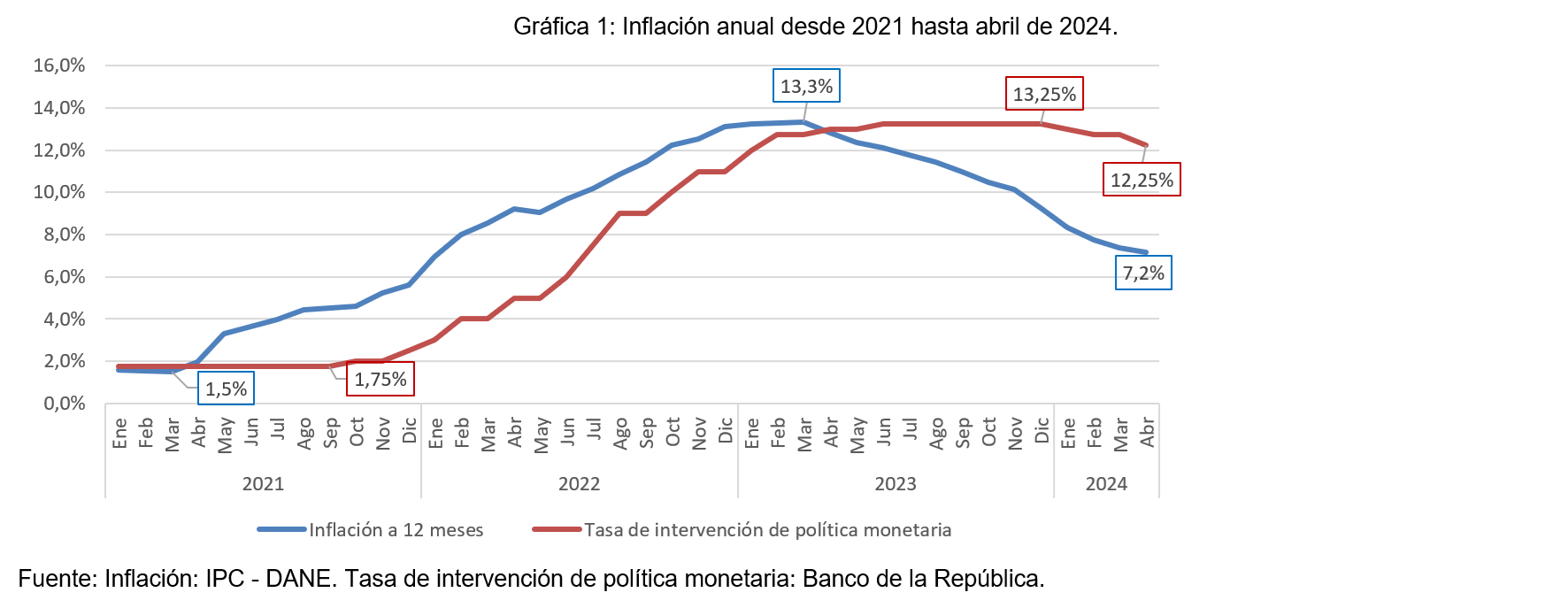
Inflation reached its maximum value of 13.3% in the first quarter of 2023, from then on, a systematic fall of the indicator was observed until reaching a figure of 7.2% in 12 months after April 2024. In turn, as shown in the graph, interest rates have started their downward path, however, this process will take the remainder of 2024 and probably part of 2025.
Inflation and interest rates on economic performance
The greatest difficulty generated by inflation, beyond the evident loss of purchasing power in households, is that it generates an unmitigable increase in the cost of credit. Unlike the cost of inputs, in which producers can transfer the higher value to consumers through the price, when the price of credit increases through a higher interest rate, those units that require loans to finance their operation or possible investment end up paying a much higher present and future value than those who do not require credit, which puts them at a clear disadvantage. In addition to this, inflation brings with it uncertainty, as the cost of credit also increases for consumers or customers, generating an expectation of a drop in sales.
This has two direct consequences on the economy: first, on the demand side where, in addition to the drop in household purchases, companies decide to postpone investment decisions; second, given the increase in the costs associated with debt repayment, the value added of the economy falls. This can be seen in national finances, where it was observed that, once inflation shot up at the end of 2022 and beginning of 2023, the economy slowed down progressively until there was even a decrease in the third quarter of 2023, consumption levels close to zero and generalized falls in investment, as shown in Graph 2.
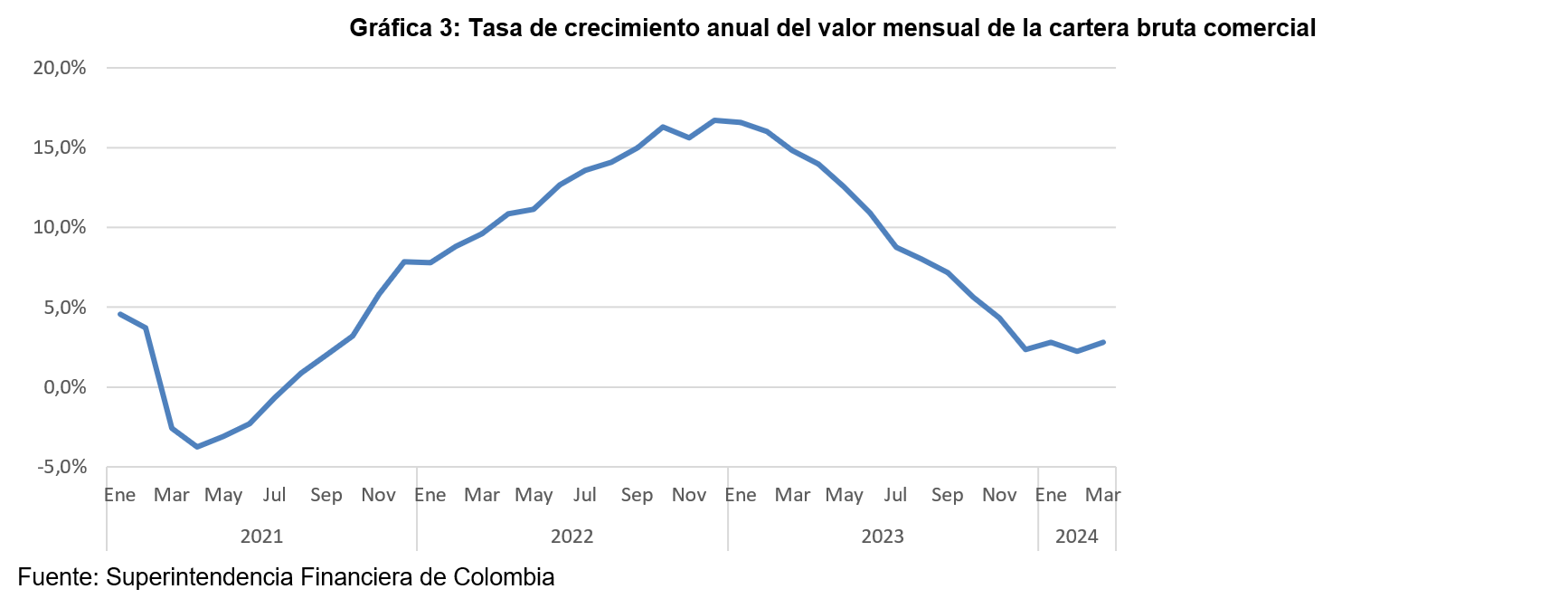
When the evolution of the commercial loan portfolio is observed, based on the figures of the Financial Superintendence of Colombia, a significant growth of the portfolio in 2022 is indeed observed, especially due to the statistical effect of comparing it with a discrete period, which was 2021. But when the credit problem intensifies in 2023, the loss of dynamics of the commercial portfolio is observed. As of January 2024, there is a stabilization in the growth of this indicator, as shown in Graph 3.
What is forecast for the following months
As mentioned above, the fall in inflation, although followed by a delay of about half a year to have a direct impact on monetary policy intervention interest rates, sends clear signals to the market of financial institutions, which may even anticipate downward movements in the price of credit. In this context, the survey of expectations of Banco de la República for the month of May 2024 showed that experts expect inflation to close 2024 at 5.6% and below 4% for 2025, a figure that is even within the margin of the Central Bank's long-term target of 3% with a margin of 1 percentage point.
Likewise, the experts consulted by Banco de la República indicate that, in terms of the intervention rate of Banco de la República, it is expected that by December 31, 2024 it will be at 8.5% and by 2025 it will close at 6%. With this dynamic, respondents also indicated, in the April version of this statistical operation, that quarterly GDP growth for 2024 will average 1.07% for the second quarter, 1.48% for the third quarter and 1.97% for the fourth quarter of the year, showing a recovery, which, although moderate, will allow the business sector to return to a path of increased sales and income.
In the midst of the challenges that lie ahead in terms of economic growth, the future recovery in credit conditions will allow investment and innovation to rebound in the economic environment. These elements are fundamental to return to a path of employment growth, household wealth and to continue on a path of poverty reduction at the national level.


