


 Go back

Innovación
 Help and support center
 Accesibility
 Rate your expirience
How can we help you?


Your experience inspires us to improve. Please rate our website using the following survey.
If you wish to make a request, petition or suggestion, you can do so through our SPQyF system and contact us:
 Back
Back
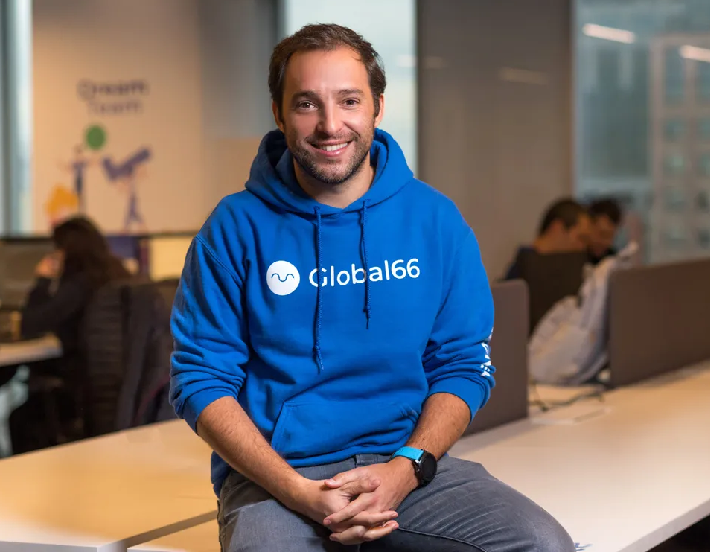

Tomás Bercovich is a Chilean businessman who has been committed to entrepreneurship since he was very young. A graduate of the Catholic University of Chile and with studies at Columbia University, he has been awarded in his country with prizes such as 'Young Entrepreneur of the Year' and 'Young Successful' by the Diario Financiero and Endeavor.
Bercovich will soon participate in Gofest, an innovation and entrepreneurship festival organized by the Bogota Chamber of Commerce (CCB), which will be held at the Agora Bogotá Convention Center from August 28 to 30 of this year.
The visible head of Global66, a startup that offers financial services and has become the first South American ally of the six-time UEFA Champions League champion, Bayern Munich, gave his impressions on the investment climate and the innovation and entrepreneurship ecosystem in the region. He also gave some advice for entrepreneurs who want to make their mark in the business world and shared his expectations regarding his imminent participation in Gofest.
How did you get the idea of being an entrepreneur? I come from a family of immigrants. My grandparents had to come to Chile and become entrepreneurs, escaping from the war. So I lived in a family that was entrepreneurial. I guess that somehow marked me.
Since I was very young I liked to do things: working as a salesman, when I was 10 or 12 years old in a ski store; then I was a waiter, when I was 15; I was a DJ, when I was 14. Then I created my first startup in college, which went badly, we didn't sell a single project. Then I got out of college, I worked for about a year in a company and at the same time I started to be an entrepreneur, I worked at night, on weekends, until I jumped into the pool and that's how we started, almost 15 years ago, a little more, maybe 16 years ago.
How do you see the entrepreneurial ecosystem in Latin America today? When I started 15 or 16 years ago, there were few entrepreneurs in Latin America, as we know them today. There was little access to capital, few funds, there were almost no angel investors, so it was complex to start a business.
I studied Civil and Industrial Engineering at the Catholic University in Chile and a professor, in a good career, in one of the most prestigious universities in Chile, told us 400 future engineers: “you are not to be entrepreneurs, you are to be the managers of large companies in this country in the coming years”.
That was the vision of entrepreneurship, I was a freak in my generation. Of the 400 engineers, we must be four or five entrepreneurs, the rest are effectively company managers today. So there was no entrepreneurship ecosystem.This has been changing in the last 15 years, more funds have come out, funds from the United States and Europe have arrived.
Several notable Latin American companies have come out, such as Mercado Libre, Globant, Nubank, etc. And there are several companies that have received significant capital, that have traction, that are not yet public, but that have done very well.
I think today is a good time to be an entrepreneur, the planets are aligned, there is capital and it is easier to attract talent compared to how it was before. Before it was very difficult to convince someone to come and work in a startup. Today, it is very attractive for a certain profile of people to come to a startup and be part of this construction path, many of them can be partners and can have stock options, so it is a different culture than the corporate culture. Today is the time to be an entrepreneur in Latin America.
We want Bogota to be a hub for innovation and entrepreneurship in Latin America. How can we make Colombia, and specifically Bogota, an attractive destination for investment?
I think there are several aspects that add up.
First, of course, by attracting top entrepreneurs and trying to make those entrepreneurs stay there. And that is done with community.We have to build it so that entrepreneurs are together, so that there is a good level of networking.
Funds must be attracted, hopefully incentives are generated at government level so that both family offices and angel investors, as well as medium-high net worth individuals, can invest with certain incentives. For example, in Chile there is CORFO, which has venture capital funds that are leveraged. For every peso that investors put in, CORFO puts in another three, so the potential profitability for the investor is higher.
In England, I lived there, there were certain tax exemptions for investors, individuals or companies. For example, the profitability was tax free, or if you lost as a natural person, that could be deductible from your tax burden.There are different mechanisms.
And the other point, I would tell you, is the regulatory one, especially in the area where I am, which is the Fintech area. It is very important that the fund regulator keeps updating rapidly to new technologies and adapting regulations to what can be done in today's world. It must have a long-term vision and openness that invites, for example, people and companies from other countries to do business in Colombia.
Let me give you a very clear example: in countries like Colombia or Chile, a foreigner cannot arrive and open an account in a bank, in a regulated Fintech, because he needs a DNI number.
In the United States, you arrive with your Colombian passport, I arrive with my Chilean passport, enter a bank branch and they give you a bank account, with a card. So, how do we want to attract foreigners or investors if we do not open an account for them? From the simplest thing, as it is, regulatory changes are required, a legal change is required to allow someone to open an account with a passport.Something that may sound so simple, is critical to really drive the take-off of an entrepreneurship and innovation hub.
I would say, then, that these are the three aspects: attracting entrepreneurs; generating community; attracting and generating incentives for investment; and, within this there is also the political aspect, the stability of the country because, for funds from the United States and Europe to come, they have to know that the rules are more or less clear and that they are not going to be running three meters this way and two meters that way.And finally, the regulatory part.
What attracted your attention to Gofest that made you decide to join us this year for the first time?
Nowadays there are events practically every day for those who want to network, almost every day there is something going on.
As an entrepreneur you have to choose, because it is impossible to go to everything, because in the end you have to be focused on your work, on building the team, on building the products, on building the company and you can't be going to a lot of events.
I can tell you an anecdote that happened to me many years ago: I had been an entrepreneur for a year and I went to an event one day. It was 8:30 in the morning and the Minister of Economy was speaking. And I met a friend, older than me, Alan Farcas, who was the executive director of Endeavor at that time here in Chile. And he said to me: “What are you doing here?” And I said to him: “What do you mean, what am I doing here? I came to see the Minister of Economy”.
And he says to me: “What do you care what the Minister of Economy says?You are doing business. Your hours have to be dedicated to work, you have to be working, making things happen”.
Going to the context, to the background, when the Minister of Economy speaks, it is something very high-level, which has little effect on what a startup does. I told him: “You are absolutely right”, grabbed my stuff and went to the office. So what I do today is that I choose a few events a year, which are the ones that add the most value because there is the ecosystem, there are other high-level entrepreneurs, because interesting people go, because it brings together many people, because there are those connections and that environment.So there are a few that you have to choose.
I have not been lucky enough to be at Gofest, but with everything I have researched when I received the invitation, it is clear that it is one of the events where you have to be.
From your expertise, what would be those three fundamental tips for an entrepreneur who wants to be successful with his project or take it to a new level?
Work with talented people, be obsessive in forming a team with a high density of talent. Be very selective in who you hire and, of course, after giving them recurring feedback, be quick to make changes in the team when necessary and maintain a high density of talent.
If you have a team of talented people, you can decide where to go.In other words, that team can lead you to do different things and if things don't go well with the initial idea, you can pivot and look for another way.If the amount of talent on the team is high, you are much more likely to find that way. That's number one.
Two, obsession in the product market fit, in really meeting a need in the market better than how it is met by those who are already there.In other words, without product market fit there is nothing.And, after product market fit, we can start thinking about the rest of things.
Third: focus on the customer. There are many entrepreneurs who start to grow and start to dedicate themselves to raising capital, to PR, to the fancy, entertaining part, but they get out of the operation and that is dangerous.In other words, I think that those who make decisions have to be very close to the client.When you start adding layers to the company and the people who make the decisions are far away from the client, it can be complicated. I, for example, read all the reviews of all the clients, every day, to understand what is happening with them.
And the fourth thing, I would say, long-term vision, that is, write a strategy, set a long-term goal.There will be thousands of bumps in the road. There is a book I love, 'The Obstacle Is the Way', but if you are very clear about where you want to get to, what the objective is, you take small steps, even if they are not so big, but step by step, in that direction, in the end the probability of achieving it is higher.
What can we expect from your presence and your intervention at Gofest?
I want to go and try to do my bit, to see if I can help some other entrepreneurs.I started very young, at the age of 24, and my big fear was that I didn't know anything.I had not really faced the professional world. So, I tried to surround myself with people, with entrepreneurs who were ahead of me, to learn from them, to learn from the mistakes they made along the way.
So, I have come a long way, we still have a long way to go, but if the road we have traveled is useful to someone else, I would love to be able to help and pass that knowledge on to others so that they make as few mistakes as possible. So I am happy to contribute as much as I can to all the people who are going to be at Gofest, with our grain of sand and our experience.


