


 Go back

Strategies
 Help and support center
 Accesibility
 Rate your expirience
How can we help you?


Your experience inspires us to improve. Please rate our website using the following survey.
If you wish to make a request, petition or suggestion, you can do so through our SPQyF system and contact us:
 Back
Back

In this sense, the CCB conducted a survey on gender gaps in the work environment, expanding the analysis related to the role of women in business decision making. The survey was conducted at the end of 2023 and addresses the challenges faced by women as employees. It was conducted in the 19 localities of the capital, surveying men and women aged 18 and older, with at least 2 years of work experience in the last decade.
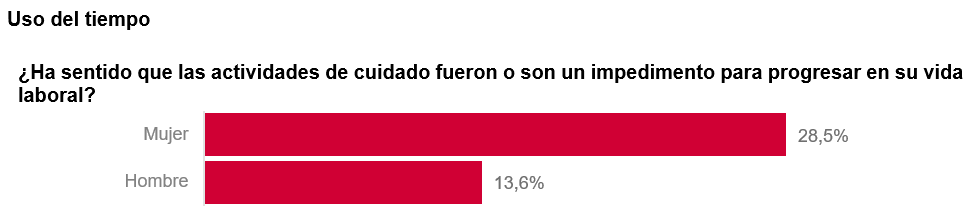
Regarding the use of time, 28.5% of women mentioned that caregiving responsibilities were an obstacle to their work progress, compared to 13.6% of men. Despite this, 35.9 % of men said they do more than their share at home, while only 12.1 % of women mentioned this.
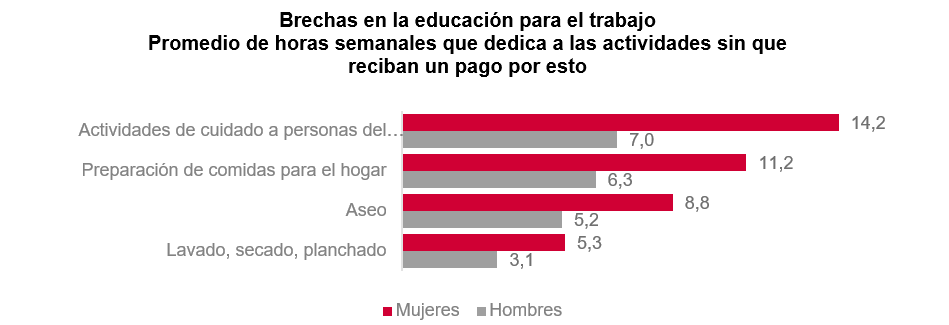
Women dedicate an average of 14.2 hours per week to care activities, compared to 7 hours for men. In addition, disparities are observed in the hours dedicated to meal preparation, where women dedicate an average of 11.2 hours per week, and men 6.3; in washing, drying and ironing, women dedicate 5.3 hours and men 3.1.
In education, there are differences in terms of the careers studied by women. STEM careers, with great growth potential, are less studied by women. In particular, higher proportions of women are observed in areas related to health and wellness, with 78.4% of the total number of professionals associated with them; followed by education, with 68.8% and business administration, with 63.1%. On the other hand, the careers with the highest proportion of men are those associated with information and communication technologies with 72 %; engineering, industry and construction with 70.6 %; and those related to the agricultural, forestry, fishing and veterinary sectors with 60.1 %.
It is crucial to close gaps early in education to ensure equal access to STEM careers for men and women, and to avoid biases in career choice, which would help reduce gender wage and occupational disparities.

12.2% of women study engineering or information and communication technologies, while among men the percentage is 36.2%.

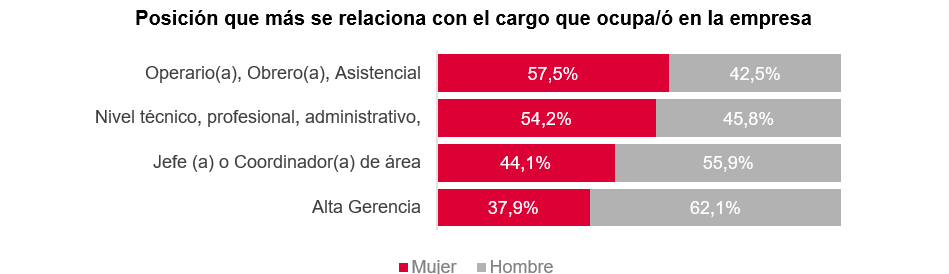
Regarding the occupation of women within the company, the results show that there is a significant gap against women, of only 24.2 percentage points at senior management levels, where 6.3% of the entire surveyed population is located. There is also a gap of 11.8 % in leadership or coordination, where 19.1 % of the surveyed population is located. These disparities are attributed to the disproportionate care burdens assumed by women, often unknown to the male population.
In professional training, there is relative equality in communication, stress management, and administrative and financial issues between men and women. However, in STEM skills, only 44.3% of those trained are women; in coordination, leadership and team management, 43.5% are women; and in corporate governance and senior management, only 41.2% are women.
Specialized literature, such as Exley and Kessler (2022) indicates that men tend to take more risks in negotiations and access to positions. The survey shows that 50% of men would apply for a job, even if they did not meet most of the requirements, compared to 44.7% of women. In addition, 60.7% of men would contact a company to apply for jobs, even without vacancies, while only 36.3% of women would do so.
The gap in negotiation skills becomes evident when 37.3 % of women accept the job offer that does not fit their needs, this proportion is 26.5 % in men, who in 38 % of the times would propose a much higher value, while this would only happen in 30.7 % of the cases in women. In the case where a job offer does not refer to salary, 63 % of women would propose the fair value for their qualifications and experience, while this would be the case for 58.4 % of men. This difference is due to the fact that 10 % of men would propose a much higher value, compared to only 4.3 % of women who would opt for this option; and, in contrast, 16.6 % of women would propose the minimum value, a figure that is 11.5 % for men.
Finally, when analyzing the propensity towards negotiation in current jobs, 31.4 % of men negotiated their salary, while this only occurred in 20 % of cases for women. It is necessary to intensify strategies to strengthen women's negotiation skills in order to reduce the gap in the promotion of individual qualities.
The survey reveals that women face discrimination in the hiring process. For example, 58.2 % have experienced questions about pregnancy, 71.1 % about children, compared to 64 % of men. In addition, 33 % of women feel that caregiving responsibilities affect their job performance, in contrast to 19.1 % of male respondents.
Women experience greater pressure to deliver results and are interrupted more frequently compared to men in the work environment. However, both men and women perceive that women's opinions are valued more in work meetings. In addition, 8 % of women have faced sexual requests at work, compared to 6.5 % of men, and 18.9 % of women have felt intimidated, while this happened to only 14.9 % of men.
Gender gaps in the work environment persist to a large extent due to a culture that assumes that women should be disproportionately and excessively assigned care and household tasks, which becomes a real constraint to professional advancement. These differences, probably originating in early stages of development, have direct consequences on educational decisions and attitude towards risk, which limits women's possibility of accessing leadership positions. This type of situation is combined with recruitment and work environments that favor men and systematically exclude women, in many cases, without a clear awareness that these problems occur.


